
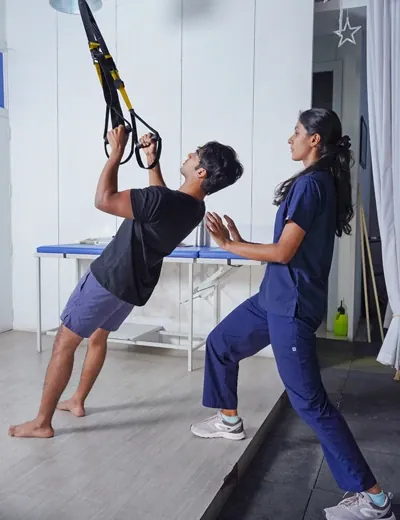
At a glance
- 1A method using repeated movements to find what may ease symptoms.
- 2One part of a wider plan, chosen after your assessment.
What is the McKenzie method?
The McKenzie method is also called Mechanical Diagnosis and Therapy, or MDT. During your session, your physiotherapist may ask you to repeat certain movements or hold certain positions. They then check with you how your symptoms change. For example, you might bend backwards or forwards several times, or move your neck in one direction, and then say how it feels. These movements are chosen for you after your assessment, so please do not try them on your own first.
The aim is to find which directions of movement may ease your symptoms and which ones may make them worse. If a direction that eases your symptoms is found, you learn simple exercises to do on your own. This aims to help you manage your symptoms and feel more in control. The method is used mainly for back and neck pain, and also for some joints in the arms and legs.
It is usually combined with other exercises, posture advice and, where it suits you, hands-on treatment, rather than used alone. Your physiotherapist plans this mix with you.
Problems it is often used for
- Lower back painRepeated movements can help show which directions may ease pain in the lower back. This includes mechanical back pain, which comes from the joints, muscles, discs or fascia (the tissue that wraps around muscles) of the spine. Our short guide to mechanical back pain explains more.
- Disc-related back painThe method is often used for back pain that may be linked to a disc. Your physiotherapist checks how your back responds to repeated movements.
- Upper back painWe assess the upper back as well as the lower back, and repeated movements may be part of your plan.
- Neck painRepeated neck movements and posture advice may help with aching after long hours on a phone or computer.
- Some arm and leg jointsThe method is also used for some joints in the arms and legs, and your physiotherapist checks whether it suits you.
How we use it at Mobiphysio
- Assessment comes firstYour physiotherapist listens to your story and checks how the area moves. Where relevant, they may also check feeling, strength and reflexes. They then explain whether the McKenzie method may suit you, so you can decide together.
- Who uses it hereDr. T.R. Vandana, PT, our founder and senior physiotherapist, is trained in the McKenzie method. Our physiotherapists use it in treatment.
- One part of your planIt is often combined with other methods our physiotherapists use, along with exercises and posture advice. These include Mulligan (mobilisation with movement) and Stecco (fascial manipulation). We explain the options, and you decide with us.
- Exercises you can do yourselfYou learn movements to do on your own at home. Your physiotherapist checks and adjusts them at follow-up visits.
What to expect in a session
Treatment at Mobiphysio is one-on-one. A first visit takes 45 to 60 minutes, and follow-up visits take 30 to 45 minutes.
You tell your physiotherapist where you feel pain, when it started and what makes it better or worse. Please bring any reports, scans or prescriptions you have.
You stand, sit or lie down and repeat a movement several times, or hold a position. This could be bending backwards or forwards, or turning your neck. You can ask to stop or change anything that feels uncomfortable at any point.
After each set, you say how your symptoms feel: better, worse, the same, or in a different place. This helps your physiotherapist find which directions may ease them.
You learn simple exercises to do at home and how often to do them. If your pain gets worse, or spreads further into your arm or leg, stop and message or call us for advice.
At follow-up visits, your physiotherapist checks how you are getting on and adjusts your exercises and plan.
Common questions
Does the McKenzie method hurt?
The movements are guided and done at a pace that suits you. Some may feel a little uncomfortable while your physiotherapist looks for directions that may help. You can ask to stop or change anything at any time.
Is it safe for me?
Your physiotherapist checks first whether it suits you, for example if you are pregnant or have recently given birth. In these cases we go ahead only with your doctor's okay, so please bring any note or reports from your doctor. If you have had an operation, follow your surgeon's instructions alongside physiotherapy. The movements are guided and adjusted to how you respond.
How is it different from a massage or other methods?
A massage is mainly hands-on work on the muscles. The McKenzie method is mostly movements you do yourself, guided by your physiotherapist, so you can keep doing them at home. Your physiotherapist may also use hands-on methods if they suit you. These include Mulligan (mobilisation with movement) and Stecco (fascial manipulation).
How many sessions will I need?
It depends on what your assessment shows and how you respond to treatment. Your physiotherapist will talk this through with you and review your plan as you go.
Will I do other exercises too?
Usually, yes. The method is often combined with other exercises, such as core stabilisation exercises, and with posture advice. Your physiotherapist will show you what suits you.
Book an assessment
 Mobiphysio physiotherapists · RS Puram and Goldwins
Would you like to know whether the McKenzie method may suit you? WhatsApp or call us on +91 73385 65909 to book an assessment. No doctor's referral is needed. Dr. T.R. Vandana, PT, and her team bring 25+ years of experience in physiotherapy and have treated 3000+ patients.
You can visit either branch:
- RS Puram: No.28, Captain Palaniswamy Layout, opposite the municipal park, RS Puram, Coimbatore 641 002. Open Monday to Saturday, 10 AM to 8 PM.
- Goldwins, Avinashi Road: 11/23, Avinashi Road, opposite Sri Sai Dental Clinic, Karuparampalayam Pirivu, Coimbatore 641 014. Open Monday to Saturday, 8 AM to 1 PM and 4 PM to 8 PM.
Both branches are closed on Sundays and major festival days such as Pongal and Diwali. Both have ample car parking. Our staff speak Tamil and English. You can ask for a particular physiotherapist, or a female physiotherapist, at either branch.
Message us on WhatsApp or call; we will answer your questions.