
At a glance
- 1Pes anserine bursitis: irritation of a bursa or tendons on the inner knee, just below the joint.
- 2Physiotherapy aims to ease pain through strengthening, stretching and hands-on care.
What is pes anserine bursitis?
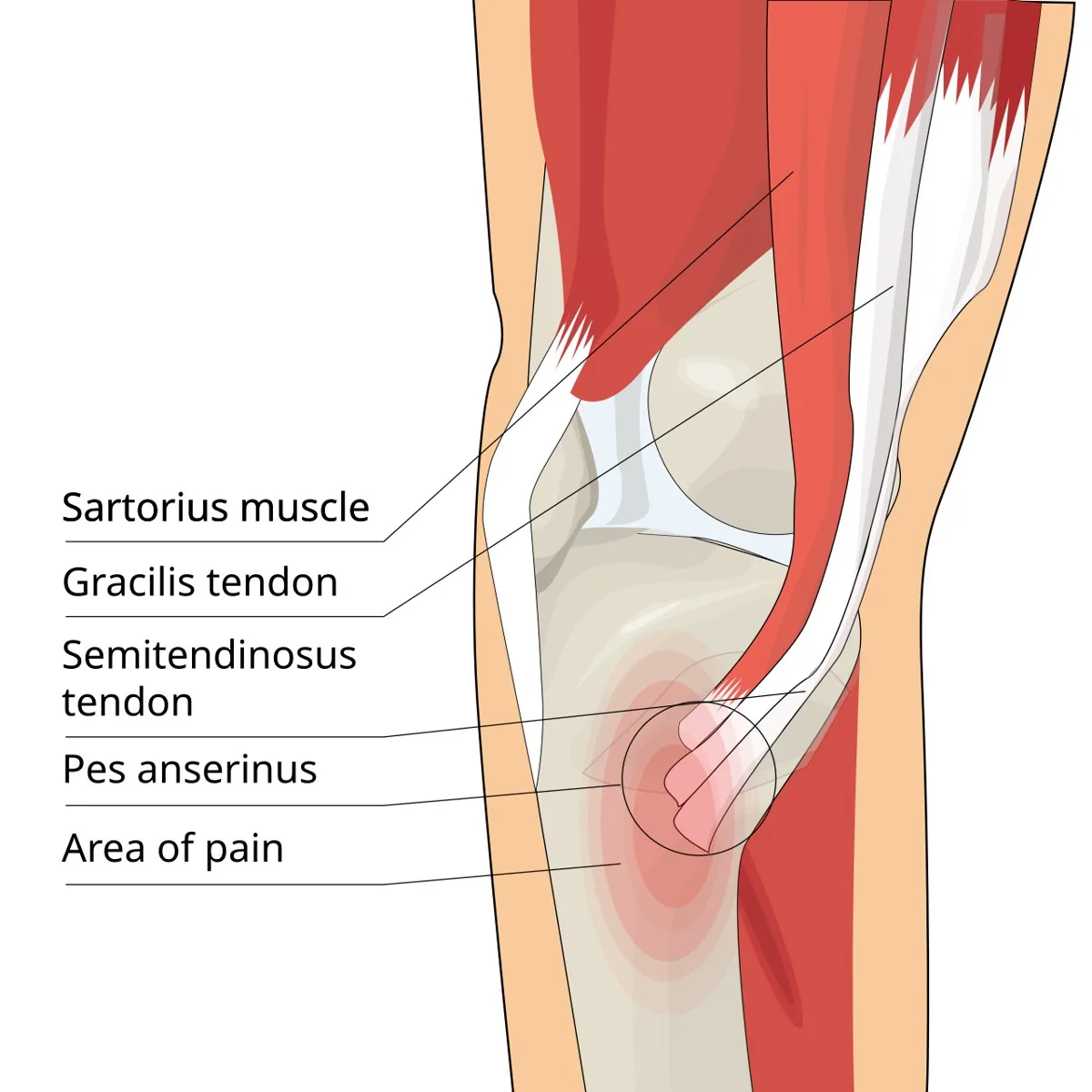
Just below the knee, on the inner side of the shin bone, three tendons join and attach to the bone. They come from muscles at the front, inner side and back of the thigh, including one of the hamstrings. Together they look a little like a goose's foot, which is what "pes anserinus" means in Latin.
Under these tendons sits a small, fluid-filled sac called a bursa. It works like a cushion, helping the tendons glide smoothly as you bend and straighten your knee. When the bursa or the tendons above it become irritated, the area can feel sore and tender. Pain here is often called pes anserine bursitis, even when the tendons, rather than the bursa, are mainly involved.
It is often seen in adults, especially women in midlife and people with knee arthritis. People often describe:
- tenderness on the inner knee, a little below the joint
- pain on stairs or when rising from a chair
- discomfort at night when lying on one side with the knees touching
Pain in this area can also come from the knee joint, the inner knee ligament or the cartilage. A physiotherapist can help work out what is likely behind your pain.
Swelling over the front of the kneecap from kneeling is a different problem, with its own guide.
Common causes
There is often no single cause. Things that may play a part include:
- Knee arthritis. Changes in the joint can alter how you walk and how your inner knee takes load.
- Tight muscles. Tight hamstrings and inner-thigh muscles may pull harder on the tendons.
- Weak thigh and hip muscles. The inner knee may then take more of the load.
- How the leg lines up. Knees that drift inward, or flat feet, can add stress to the inner knee.
- Overuse. Lots of stairs, hill walking, running or sports with quick turns can irritate the area.
- A knock to the knee. A direct blow to the inner knee can irritate the bursa.
Your physiotherapist will look at which of these may apply to you.
How physiotherapy at Mobiphysio can help
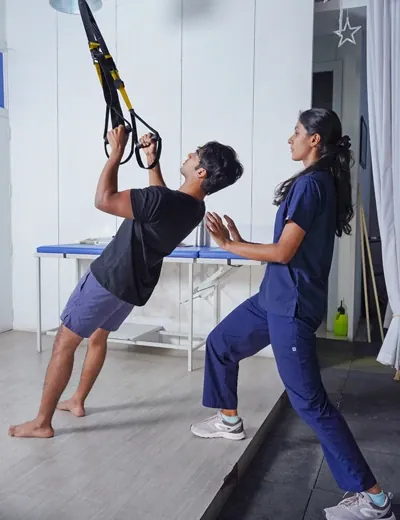
Treatment at Mobiphysio is one-on-one and starts with a thorough assessment. We aim to settle the sore area, then build strength and flexibility so your knee copes better with daily life. Your plan may include:
- Strengthening.Exercises for the thigh and hip muscles aim to support the knee and take strain off the inner side. We start gently and build up at your pace.
- Stretching.Gentle, slow stretches for the hamstrings and inner thigh can help ease the pull on the tendons.
- Hands-on care.Massage and other hands-on techniques may ease pain and help the knee move more comfortably. Depending on your assessment, your physiotherapist may use hands-on methods such as Mulligan (gently guiding the joint while you move) or Stecco (firm, focused work on the fascia, the thin layer that wraps the muscles).
- Other options.Electrotherapy (treatment using mild electrical currents) and ultrasound therapy (treatment using sound waves) are available at both branches. They may be used if they fit your plan. Your physiotherapist can also advise whether heat or a cold pack at home suits your knee.
- Everyday habits.We look at how you climb stairs, rise from a chair and sleep. We then suggest small changes that may reduce strain.
If you also have knee arthritis, your plan takes both into account. We listen, you decide: we explain the options, and you choose what fits your life. Results differ from person to person.
What to expect at your visits
Your first visit takes 45 to 60 minutes, and follow-up visits take 30 to 45 minutes. You do not need a doctor's referral. At the first visit:
- We ask about your pain, your daily routine and what makes it worse.
- Your physiotherapist examines your knee and watches how you walk, bend and stand up from a chair.
- We explain what may be causing the pain and suggest a plan.
- You learn simple exercises to start with at home.
At follow-up visits, we check how your knee is responding and adjust your exercises and care.
Bring any reports, scans or prescriptions you have. You can ask for a particular physiotherapist, or a female physiotherapist, at both branches. Our team speaks Tamil and English.
Things you can try at home
These simple ideas may ease strain on the inner knee. Move slowly and stay within comfort.
- Pillow between knees.
If you sleep on your side, place a pillow between your knees. This may ease pressure on the inner knee at night.
- Gentle hamstring stretch.
Sit near the front of a firm, steady chair, ideally with its back against a wall. Straighten one leg with the heel on the floor. Keep your back straight and lean forward gently from your hips until you feel a mild stretch behind the thigh. Hold for a few slow breaths.
- Gentle inner-thigh stretch.
Lie on your back on a bed with knees bent and feet together. Let your knees slowly fall apart only as far as feels comfortable, to a mild stretch along the inner thighs. You can rest each knee on a pillow. Hold for a few slow breaths, then bring your knees back together.
- Sit-to-stand practice.
Place a steady chair against a wall. Stand up slowly, then sit back down with control, keeping your knees in line with your toes. Start with a few and use the armrests if you need them. If this hurts, try a higher seat or add a firm cushion.
- Take stairs slowly.
Hold the handrail and take one step at a time. Going up, lead with your less painful leg. Going down, lead with the sore leg.
Stop and get advice if pain gets worse. These ideas are general and do not replace an assessment. If you have had a knee operation, follow your surgeon's instructions alongside physiotherapy.
Common questions
Why does the inner knee often hurt more on stairs?
Climbing stairs and rising from a chair make the muscles that cross the inner knee work hard. This may press on and irritate a sore bursa or tendons. A physiotherapist can check how your knee and hip move during these tasks.
Is this the same as knee arthritis?
No. Pes anserine bursitis affects a bursa and tendons just below the joint, while arthritis affects the joint itself. The two can happen together, and an assessment can help tell them apart.
Can I sit cross-legged or on the floor?
For some people, deep bending such as sitting cross-legged or getting up from the floor bothers a sore inner knee. If it hurts, a chair may feel easier for now. Your physiotherapist can talk through what suits your knee.
Can physiotherapy help pain on the inner side of the knee?
It can help. Physiotherapy aims to ease pain, stretch tight muscles and strengthen the thigh and hip. Results differ from person to person.
Do I need a doctor's referral?
No, you do not need a referral. Bring any reports, scans or prescriptions you have.
Can I ask for a female physiotherapist?
Yes. You can ask for a female physiotherapist, or a particular physiotherapist, at both branches. Just mention it when you WhatsApp or call to book.
Book an assessment
 Mobiphysio physiotherapists · RS Puram and Goldwins
If the inner side of your knee hurts on stairs or when you rise from a chair, an assessment can help you understand what may be going on. WhatsApp or call +91 73385 65909 to book (open WhatsApp).
Dr. T.R. Vandana, PT, and her team have 25+ years of experience in physiotherapy and have treated 3000+ patients. Visit us at either branch:
- RS Puram: No.28, Captain Palaniswamy Layout, opposite the municipal park, RS Puram, Coimbatore 641 002. Monday to Saturday, 10 AM to 8 PM. Google Maps
- Goldwins, Avinashi Road: 11/23, Avinashi Road, opposite Sri Sai Dental Clinic, Karuparampalayam Pirivu, Coimbatore 641 014. Monday to Saturday, 8 AM to 1 PM and 4 PM to 8 PM. Google Maps
Both branches are closed on Sundays and major festival days such as Pongal and Diwali. There is ample car parking at both branches. Tell us when you book if stairs are hard for you.
Message us on WhatsApp or call; we will answer your questions.