
At a glance
- 1An elbow sprain means an elbow ligament is overstretched or torn.
- 2Physiotherapy aims to ease pain, restore movement and rebuild grip strength.
What is an elbow sprain?
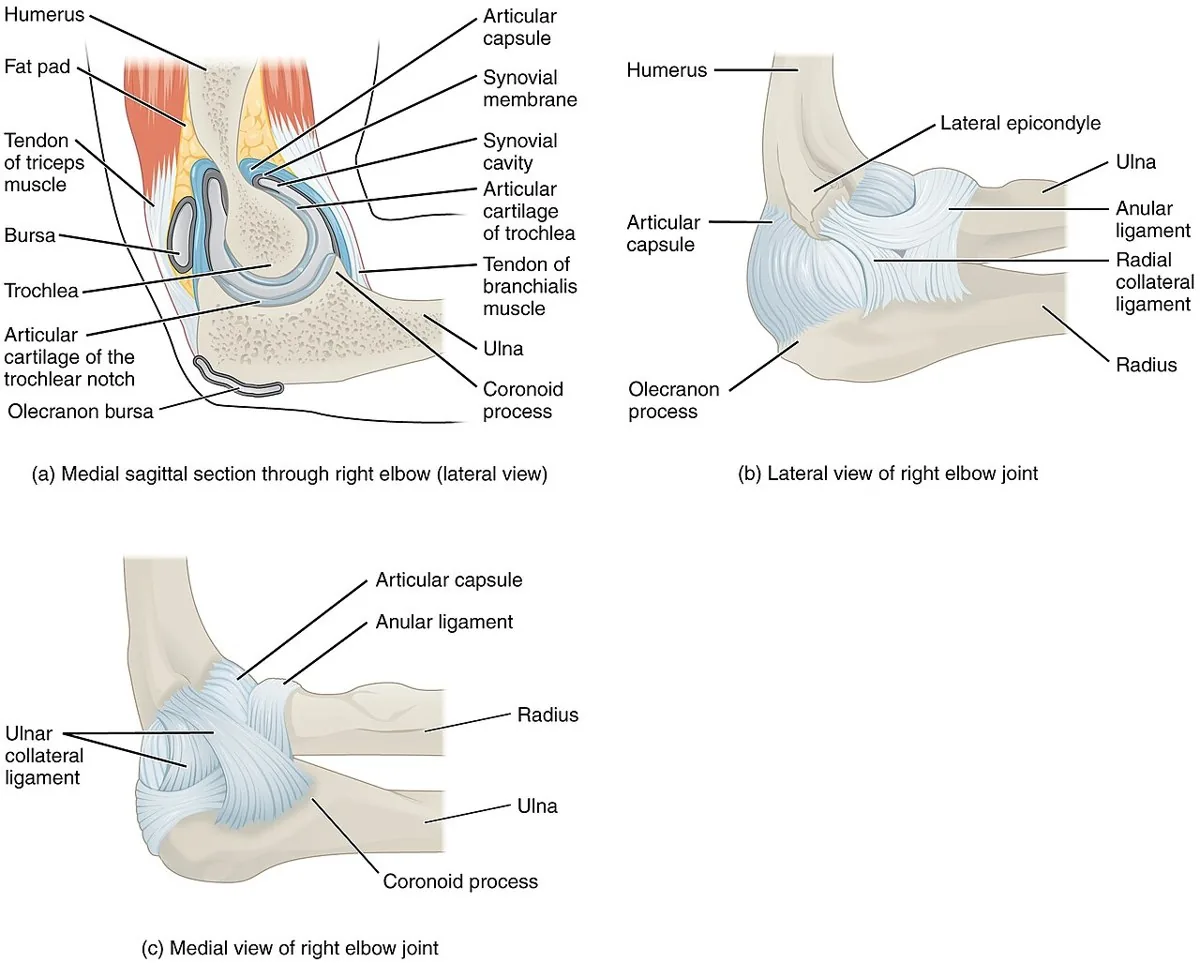
Ligaments are strong bands of tissue that hold bones together at a joint. Your elbow has ligaments on the inner side and the outer side. It also has a ring-shaped one that holds the top of a forearm bone in place. Together they keep the elbow steady when you bend, straighten, twist your forearm or take weight through your arm.
A sprain happens when one or more of these ligaments is stretched too far. Some sprains are a mild overstretch. Others involve a partial or complete tear of the ligament. How much it hurts does not always show how much the ligament has been injured.
After a sprain, people often notice:
- Pain around the elbow, especially when bending, straightening or turning the forearm
- Swelling or bruising
- Stiffness that makes it hard to bend or straighten the arm fully
- A weaker grip, or trouble lifting a bag, bucket or kettle
These signs can also come from other elbow problems, such as a muscle or tendon injury. That is why an assessment by a physiotherapist matters. Your physiotherapist will examine your elbow and explain what they find in plain words.
Common causes
Most elbow sprains happen when the joint is pushed further than it can comfortably go. Common causes include:
- A fall onto an outstretched hand. Putting a hand out to catch yourself sends force up the arm to the elbow. This can happen with a slip on a wet floor, a missed step or a fall from a two-wheeler.
- An awkward twist. A sudden twist of the forearm can overstretch a ligament. Examples include lifting something heavy at an odd angle or grabbing a falling object.
- A throwing action. A hard throw, such as returning a cricket ball from the outfield, puts strain on the inner side of the elbow. Repeated throws without enough rest can add up over time.
- A sudden heavy load. Taking a heavy weight suddenly on a straight arm can strain the elbow. This can happen at the gym, at work or at home.
How physiotherapy at Mobiphysio can help
At Mobiphysio, our physiotherapists are led by Dr. T.R. Vandana, PT, and every plan is personalised to you. Treatment is one-on-one and starts with a thorough assessment. For a sprained elbow, we usually work towards three goals.
Calm pain and swelling. Early on, your physiotherapist will show you how to protect the elbow and how much to use it. This can help pain and swelling settle. Electrotherapy or ultrasound therapy, available at both branches, may be used to help ease pain. Gentle hands-on techniques may also help the area settle.
Restore full movement. A sprained elbow often stiffens. Manual therapy uses hands-on techniques that aim to improve how the elbow joint moves. Massage can help release tight soft tissue around it. Methods such as Mulligan may be part of this, depending on what your elbow needs.
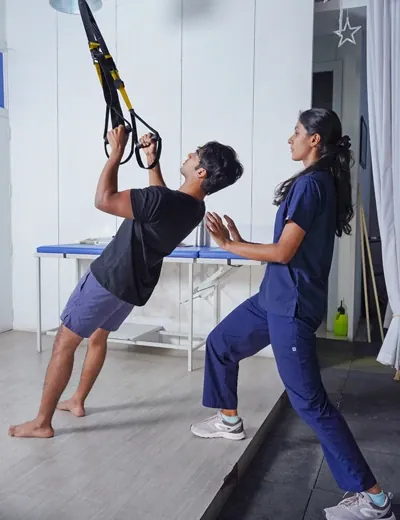
Rebuild grip and arm strength. When your physiotherapist feels your elbow is ready, exercises such as wrist turns, wrist curls and towel twists can help build strength, flexibility and joint control. Your physiotherapist will choose and progress these for you. They may also look at your wrist and shoulder, because the whole arm works together. If you throw in sport or lift at work, your plan can include a step-by-step return to those tasks.
Dry needling may also be used where suitable; Dr. T.R. Vandana, PT is trained in it. We listen, you decide: your physiotherapist will explain each option, and you choose what suits you.
What to expect at your visits
Every visit is one-on-one. Your first visit takes 45 to 60 minutes and starts with a thorough assessment:
- We listen to your story: how you hurt your elbow, when the pain started and what makes it worse.
- Your physiotherapist examines your elbow, arm and movement, including how you bend, straighten, twist and grip.
- We look at any reports, scans or prescriptions you bring, as they can help guide your plan.
- You get a personalised plan and simple exercises to begin.
Follow-up visits take 30 to 45 minutes. At each one, your physiotherapist checks how your elbow is responding. They continue hands-on treatment where needed and move your exercises forward step by step. Your plan changes as your elbow changes.
Things you can try at home
These ideas are gentle and general, and they do not replace an assessment. Stop and get advice if pain gets worse.
- Use a cold pack.
Early on, wrap a cold pack or ice in a thin cloth. Rest it on the sore area for short spells. Never put ice straight on your skin. Check your skin often, and take the pack off if your skin feels numb or starts to burn.
- Bend and straighten gently.
Slowly bend and straighten your elbow a few times. Stay within comfort and never force it. Gentle movement may help stop the joint getting stiff.
- Pause heavy lifting.
Avoid heavy lifting, pulling and throwing for now, and carry bags in your other hand. Ask family to help with heavy buckets, water cans or shopping.
- Keep your hand moving.
Gently open and close your hand, and move your wrist and fingers within comfort. This keeps the rest of your arm active while the elbow settles.
If any step makes your pain worse, stop and get advice from a physiotherapist.
Common questions
Is a sprained elbow the same as tennis elbow?
No, they are different problems. A sprain is an injury to a ligament, usually from a sudden force such as a fall, twist or throw. Tennis elbow is a problem with the tendons on the outer side of the elbow. It usually builds up slowly with repeated gripping or wrist movements. Both can cause pain on the outer side, so a physiotherapist can assess what is behind your pain.
Should I keep my elbow completely still until it heals?
Often not. Keeping the elbow completely still for a long time can leave it stiff, and gentle bending and straightening within comfort is often a good start. Some elbow injuries need extra support for a while. Your physiotherapist will tell you after your assessment how much to move it. Stop and get advice if pain gets worse.
Should I use ice or a hot water bag?
Early on, many people find a cold pack wrapped in a cloth soothing. Ask your physiotherapist before using heat, as what helps can change as your elbow settles.
Can I keep playing cricket or going to the gym?
It is wise to take a break from throwing and heavy lifting while your elbow is sore. Your physiotherapist can plan a gradual, step-by-step return that suits your sport or training.
Do I need a doctor's referral?
No referral is needed. Please bring any reports, scans or prescriptions you have to your first visit.
Can I ask for a female physiotherapist?
Yes. You can ask for a particular physiotherapist, or a female physiotherapist, at both branches. Just mention it when you WhatsApp or call to book.
Book an assessment
 Mobiphysio physiotherapists · RS Puram and Goldwins
Is your elbow still sore, stiff or weak after a fall, twist or throw? A physiotherapy assessment can help you understand what is going on. WhatsApp or call +91 73385 65909 to book your visit (open WhatsApp).
Our team brings 25+ years of experience in physiotherapy and has treated 3000+ patients. Staff speak Tamil and English.
Visit either branch:
- RS Puram: No.28, Captain Palaniswamy Layout, opposite the municipal park, RS Puram, Coimbatore 641 002. Monday to Saturday, 10 AM to 8 PM. Google Maps
- Goldwins, Avinashi Road: 11/23, Avinashi Road, opposite Sri Sai Dental Clinic, Karuparampalayam Pirivu, Coimbatore 641 014. Monday to Saturday, 8 AM to 1 PM and 4 PM to 8 PM. Google Maps
Both branches are closed on Sundays and major festival days such as Pongal and Diwali. There is ample car parking at both branches.
Have a question before you book? Message us on WhatsApp or call; we will answer your questions.