
At a glance
- 1What it is: pain where the spine meets the pelvis, often one-sided.
- 2How physiotherapy may help: hands-on care, hip and core strengthening.
What is sacroiliac joint pain?
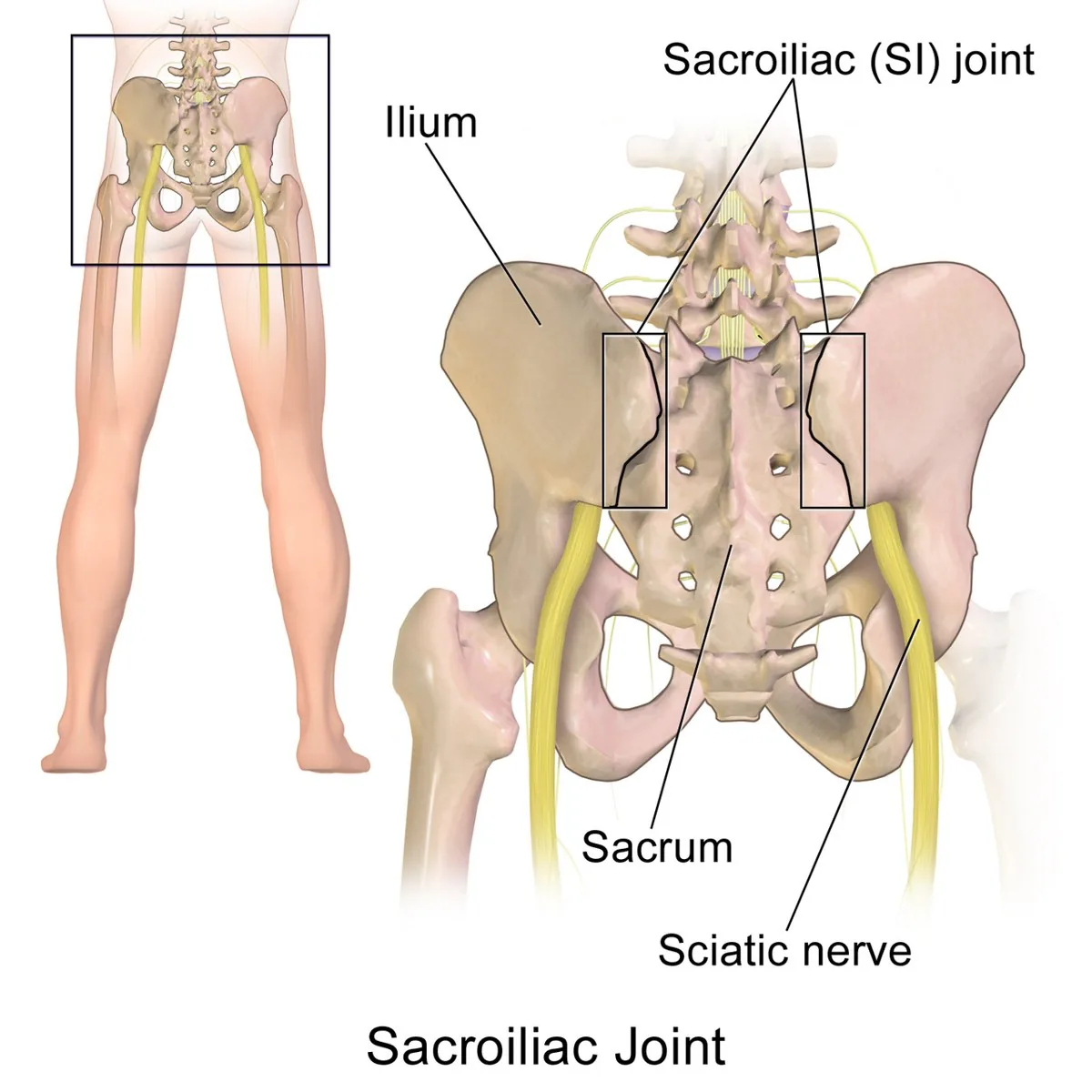
At the base of your spine is a triangle-shaped bone called the sacrum. On each side, it joins the pelvis at a sacroiliac joint, often called the SI joint. If you find the two small dimples just above your buttocks, the joints sit roughly beneath them.
The SI joints move only a little. Strong ligaments hold them steady as they pass the weight of your upper body down into your legs. They share the load each time you walk, bend or get up from a chair.
When an SI joint is irritated, pain is usually felt on one side of the very low back or in the buttock. Some people also notice it spreading into the back of the thigh. It is often worse when climbing stairs, turning in bed or standing on one leg.
Pain in this area can also come from the lower back, the hip or nearby muscles. That is why a careful assessment by a physiotherapist matters before treatment starts.
Common causes
SI joint pain often comes from a mix of things rather than one cause. Common ones include:
- Joint strain: a fall onto the buttock, a sudden twist, a missed step, or lifting something heavy awkwardly.
- Muscle imbalance: weak buttock, hip or core muscles, or tight muscles on one side.
- One-sided habits: standing with your weight on one leg, carrying a child on one hip, or always crossing the same leg.
- Long sitting or standing: hours in one position at a desk, behind the wheel or at a shop counter.
- Sport: running and kicking sports, or a sudden jump in training.
- Arthritis: this can affect the SI joints as well as other joints.
Muscles around the hip, buttock and trunk work together to keep the pelvis steady. When some are weak or tired and others are tight, the SI joint may take more strain than it should and become irritated.
Pelvic pain during pregnancy or after birth has its own guide. At Mobiphysio, pregnancy and after-birth care is given with your doctor's okay.
How physiotherapy at Mobiphysio can help
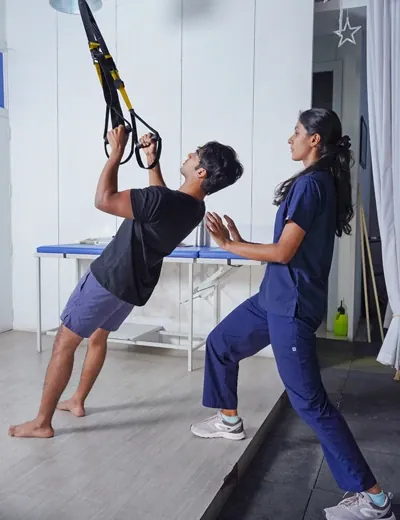
Treatment at Mobiphysio is one-on-one and starts with a thorough assessment of your back, pelvis and hips. We aim to find what is causing your pain, not just where it hurts.
Depending on what we find, your plan may include:
- Hands-on care: manual therapy that aims to ease pain and improve movement.
- Hip and buttock strengthening: exercises for the muscles that help keep your pelvis steady on stairs and on one leg.
- Core strengthening: gentle work for the deep trunk muscles, built up step by step.
- Electrotherapy or ultrasound therapy: available at both branches and may be used alongside exercise and hands-on care.
- Advice for daily life: simple changes to how you sit, sleep, lift and use stairs.
- A step-by-step plan: to help you return to work, daily tasks and sport.
Our physiotherapists use McKenzie, Mulligan and Stecco methods.
Mobiphysio is led by Dr. T.R. Vandana, PT, who is trained in Mulligan, McKenzie, Stecco Fascial Manipulation and Dynamic Neuromuscular Stabilization (DNS). Results differ from person to person, so we explain your options, and you decide on the plan with us.
What to expect at your visits
At your first visit:
- We listen to your story: when the pain started, where it hurts, and what makes it better or worse.
- Your physiotherapist checks your back, pelvis and hips, and tests key muscles with gentle pressure.
- We explain what may be causing the pain and suggest a plan.
- You may begin treatment and learn simple exercises to try at home.
Your first visit takes 45 to 60 minutes, and follow-up visits take 30 to 45 minutes.
Bring any reports, scans or prescriptions you have. Our staff speak Tamil and English, and both branches have ample car parking. Tell us when you book if stairs are hard for you.
From a selected Google review:
> "Since my lower back injury, I've never been able to relax my back, glutes, and legs. … From my very first visit, I immediately felt Dr. Vandana's professionalism and experience. The care I received was excellent."
> — Marco R., Google review
Individual experiences vary.
Read reviews on Google: RS Puram · Goldwins
<!-- Page note: review text fetched from Google on 12 Nov 2026. -->
Things you can try at home
These gentle, general ideas suit most people. Move slowly and stay within comfort.
If you have had an operation on your back or hip, follow your surgeon's instructions alongside physiotherapy. If you are pregnant, our guide on pelvic girdle pain in pregnancy has ideas suited to you.
- Gentle buttock stretch.
Lie on your back with knees bent. Hold behind one thigh and gently draw that knee towards your chest until you notice a mild stretch in the buttock or lower back. Hold for a few slow breaths, then swap sides.
- Pillow between knees.
When you lie on your side, place a pillow between your knees to keep your hips level. To turn over, keep your knees together and roll your whole body as one piece.
- Go easy on stairs.
Take one step at a time, holding the rail if there is one. Many people find it easier to lead with the less sore leg going up and the sorer leg going down.
- Sit to get dressed.
Sit down to put on trousers, socks and shoes, so you do not have to balance on one leg. When standing, try to keep your weight even on both legs.
- Keep gently moving.
Short, easy walks and regular breaks from sitting may ease stiffness. Change position often rather than staying still for long.
Stop and get advice if pain gets worse. Your physiotherapist can show you exercises that suit you.
Common questions
Is this the same as sciatica or a slipped disc?
No. They are different problems, but they can cause similar pain, and more than one can be present. Buttock pain can come from the SI joint, the lower back, the hip, or nearby muscles and nerves. A physiotherapist's assessment helps work out where your pain is coming from.
Why does it hurt more on stairs or when I turn in bed?
If the SI joint is irritated, these movements can strain it, because they put weight through one side of the pelvis or twist it. Taking stairs one step at a time and sleeping with a pillow between your knees may ease this. Stop and get advice if pain gets worse.
Can I sit cross-legged on the floor or ride my two-wheeler?
Many people find that positions which twist the pelvis or load one side are uncomfortable for a while. Your physiotherapist can look at how you sit and move, and suggest changes that suit your routine.
Should I rest completely until the pain settles?
Many people find gentle, regular movement more comfortable than long periods of rest. Your physiotherapist can suggest what suits you. Stop and get advice if pain gets worse.
Do I need a doctor's referral?
No. You can book directly by WhatsApp or phone call. Please bring any reports, scans or prescriptions you have.
Can I ask for a female physiotherapist?
Yes. You can ask for a female physiotherapist, or a particular physiotherapist, at both branches. Mention it when you WhatsApp or call to book.
Book an assessment
 Mobiphysio physiotherapists · RS Puram and Goldwins
If pain low in your back or buttock is making stairs, sleep or daily tasks harder, an assessment can help you understand what is going on. WhatsApp us or call +91 73385 65909 to book at either branch.
- RS Puram: No.28, Captain Palaniswamy Layout, opposite the municipal park, RS Puram, Coimbatore 641 002. Open Monday to Saturday, 10 AM to 8 PM. Google Maps
- Goldwins, Avinashi Road: 11/23, Avinashi Road, opposite Sri Sai Dental Clinic, Karuparampalayam Pirivu, Coimbatore 641 014. Open Monday to Saturday, 8 AM to 1 PM and 4 PM to 8 PM. Google Maps
Both branches are closed on Sundays and major festival days such as Pongal and Diwali.
Dr. T.R. Vandana, PT, and her team bring 25+ years of experience in physiotherapy and have treated 3000+ patients. We listen first and plan your care with you. Have a question before you book? Message us on WhatsApp or call; we will answer your questions.