
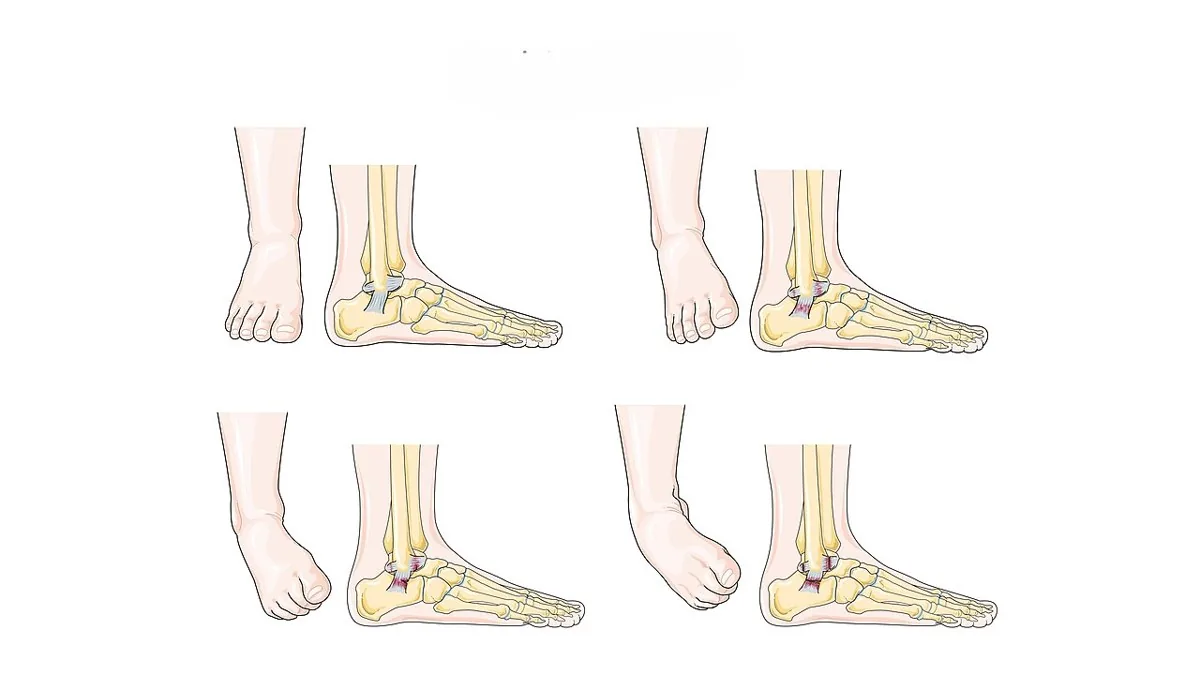
At a glance
- 1A sprain is a stretch or tear in the ankle's ligaments.
- 2Physiotherapy aims to ease pain and swelling, then rebuild strength and balance.
What is an ankle sprain?
Ligaments hold your ankle steady. They are short, strong bands of tissue that link one bone to another. When the foot twists or rolls suddenly, a ligament can be pulled further than it is meant to stretch. In a sprain, one or more ligaments are stretched or torn.
Often the foot rolls inward, so the ligaments on the outer side of the ankle take the strain. The body then reacts with pain, swelling and sometimes bruising around the joint. The ankle may be stiff, and it may hurt to stand or walk. It can also seem weak or wobbly.
Sprains vary a lot from person to person. If a sprained ankle does not get back its full strength and balance, it may stay unsteady and roll again more easily. That is why an assessment by a physiotherapist is a good first step. We check how badly the ankle is hurt and explain what we find.
Common causes
A sprain can happen in a split second. Common causes include:
- Twisting or rolling the ankle on uneven roads, potholes or rough ground
- Missing a step, or stepping awkwardly off a footpath or staircase
- Awkward landings during sport, such as cricket, football, badminton or basketball
- Sudden turns or changes of direction while playing or running
- Slipping on wet floors or walking in loose slippers
- A previous sprain that never fully regained strength and balance
How physiotherapy at Mobiphysio can help
At Mobiphysio, care is one-on-one and always starts with a thorough assessment. Our team, led by Dr. T.R. Vandana, PT, plans treatment around your ankle, your daily life and your goals. Broadly, we aim to do four things.
Calm pain and swelling. In the early days, protection, rest, ice, compression and elevation can help control swelling and ease pain. Your physiotherapist may also use ultrasound therapy (a treatment, not a scan) or electrical stimulation. They may also advise on compression support. For a recent sports injury, cold therapy (cryotherapy) may be part of your care.
Restore movement. A sprained ankle often stiffens up. Gentle exercises and hands-on manual therapy aim to ease that stiffness so the ankle moves more freely. Our physiotherapists use methods such as Mulligan and Stecco where they suit you.
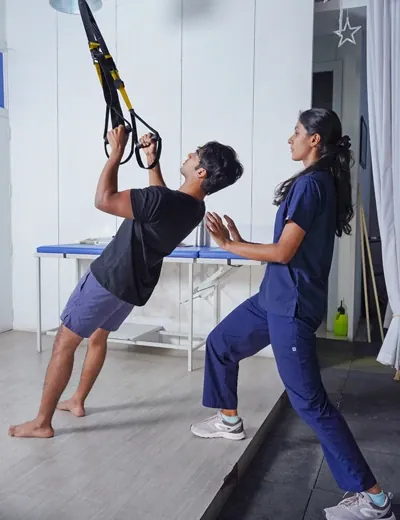
Rebuild strength and balance. Step-by-step exercises build up the muscles around the ankle and train your balance. This aims to help the joint react better on uneven ground. We also look at how you walk and help correct any limp.
Return to everyday life and sport. We bring back daily tasks, walking and sport in phases, at a pace that suits your ankle. You get advice on bracing or taping, plus a home exercise plan, to help lower the chance of another sprain. No one can promise a sprain will never happen again, but this work aims to give you a steadier ankle you can trust.
What to expect at your visits
Your first visit takes 45 to 60 minutes, and follow-up visits take 30 to 45 minutes. Every session is one-on-one with a physiotherapist.
At your first visit, we:
- Ask how the injury happened and what hurts most
- Check your ankle's movement, strength and stability
- Explain what we find and the plan in simple words
- Show you first steps and home exercises to start right away
At follow-up visits, we see how your ankle is responding. We adjust your exercises and treatment as you progress. We listen, you decide, and we explain the plan in simple words.
Please bring any reports, scans or prescriptions you have. Our staff speak Tamil and English. You can ask for a particular physiotherapist, or a female physiotherapist, at both branches.
Things you can try at home
These gentle ideas suit most people in the first few days after a twist.
- Rest and raise.
Lie back with your ankle propped up on pillows. Ideally keep it above the level of your heart, as far as is comfortable. This may help swelling settle.
- Wrapped cold pack.
Wrap a cold pack or some ice in a thin cloth. Rest it on the ankle for about 10 to 15 minutes at a time. Never put ice straight onto bare skin. Take it off if the cold becomes painful. Ask us first if the skin on your foot has poor sensation or circulation.
- Gentle early movement.
Within comfort, slowly point your toes down and then pull them back up towards you. You can also gently wiggle your toes.
- Protect the ankle.
Avoid sport, long walks and uneven ground until your physiotherapist advises that your ankle is ready. When you go out, wear supportive, well-fitting footwear rather than loose slippers.
- Listen to your pain.
Stop and get advice if pain gets worse, or if you are unsure what is safe for you. You can WhatsApp or call us to ask.
Common questions
Should I rest completely or keep my ankle moving?
Usually a balance of both. Protect and rest the ankle in the first few days, and keep it gently moving within comfort. Your physiotherapist can guide how much walking suits you.
Should I use hot water or an oil massage on a fresh sprain?
In the first few days, a cold pack wrapped in a cloth is usually preferred, as it may help ease swelling and pain. Avoid heat or firm rubbing on a fresh, swollen ankle unless your physiotherapist advises it.
Should I wear a crepe bandage or an ankle support?
Compression and support can help control swelling and protect the ankle in the early days. A bandage should be snug but not tight. Loosen it if it feels too tight or uncomfortable. Take it off at night unless your physiotherapist advises otherwise. You can ask us to show you how to wrap it. Your physiotherapist can also advise on bracing or taping that suits your ankle.
Can physiotherapy help stop my ankle from spraining again?
It aims to. Strength and balance training, with bracing or taping advice, may lower the chance of future sprains. No one can promise it will never happen again.
Do I need a doctor's referral to visit Mobiphysio?
No, you do not need a doctor's referral. Bring any reports, scans or prescriptions you have.
Book an assessment
 Mobiphysio physiotherapists · RS Puram and Goldwins
If you have twisted or rolled your ankle, a physiotherapist can assess it and plan care around you. WhatsApp or call +91 73385 65909 to book your ankle assessment. You can also open WhatsApp directly: wa.me/917338565909.
Our team brings 25+ years of experience in physiotherapy and has treated 3000+ patients. Message us on WhatsApp or call; we will answer your questions.
We have two branches in Coimbatore:
- RS Puram: No.28, Captain Palaniswamy Layout, opposite the municipal park, RS Puram, Coimbatore 641 002. Monday to Saturday, 10 AM to 8 PM. Google Maps
- Goldwins, Avinashi Road: 11/23, Avinashi Road, opposite Sri Sai Dental Clinic, Karuparampalayam Pirivu, Coimbatore 641 014. Monday to Saturday, 8 AM to 1 PM and 4 PM to 8 PM. Google Maps
Both branches are closed on Sundays and major festival days such as Pongal and Diwali. Both have ample car parking. Tell us when you book if stairs are hard for you.