
At a glance
- 1A labral tear is damage to the hip socket's soft rim.
- 2Physiotherapy aims to ease pain, build strength and improve hip control.
What is a hip labral tear?
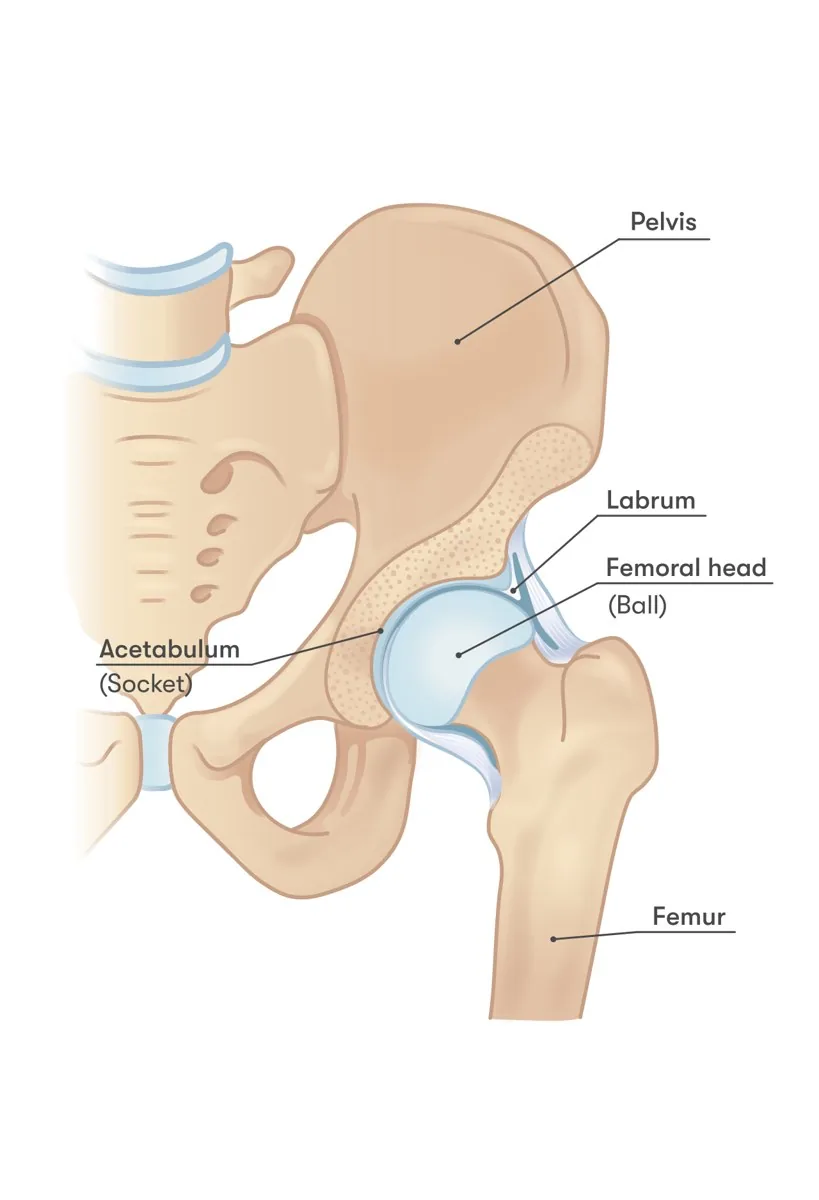
Your hip is a ball-and-socket joint. The ball at the top of your thigh bone sits in a cup-shaped socket in the pelvis. Around the rim of this socket is the labrum, a ring of tough, flexible cartilage. It helps hold the ball snugly in place and supports the joint as you move.
A labral tear means this rim has become frayed or torn. Some people notice pain deep in the groin or at the front of the hip. Some also notice clicking, catching, or a moment where the hip seems to get stuck. Pain may be worse with twisting, deep bending or sitting for a long time.
Hip impingement is different, though the two can be linked. In impingement, the shape of the ball or the socket causes the two to pinch together at the end of some movements, such as deep bending. So impingement is about how the joint surfaces meet. A labral tear is damage to the soft rim itself. Over time, repeated pinching can sometimes strain the labrum, so some people have both.
A click on its own does not mean the labrum is torn. Many things can make a hip click or catch. A physiotherapy assessment can help work out what may be going on and what to do next.
Common causes
A labral tear can build up slowly or start with one awkward moment. Common causes include:
- A twist or sharp turn, such as planting your foot and turning quickly.
- A fall or slip that jolts the hip.
- Repeated pivoting in sport, such as cricket, football, badminton or kabaddi.
- Repeated deep bending, as in some yoga poses, dance moves or heavy squats.
- Hip shape, such as impingement, where pinching may strain the labrum, or a shallow socket that puts more load on the rim.
- Wear and tear over time, as the hip carries a lot of load.
- Weak muscles or poor movement habits, which can put extra stress on the joint.
Often there is no single cause. A mix of load, movement and strength may play a part.
How physiotherapy at Mobiphysio can help
At Mobiphysio, our team led by Dr. T.R. Vandana, PT, starts with a thorough assessment. Treatment is one-on-one. We aim to ease pain, improve how your hip moves and build the strength that supports it. Your plan is based on what we find, not on a fixed routine.
- Settling things down.We guide you to ease off movements that bring on pain, such as deep twists and pivots, while you stay active in other ways.
- Strengthening.Exercises for your glutes (buttock muscles), the other muscles around the hip and your core can help support the joint. Core stability work targets the muscles of your abdomen, back and pelvis.
- Movement control.We look at how you squat, step, land and turn. Small changes in how you control these movements may ease the strain on your hip.
- Hands-on care.Massage and other hands-on methods aim to ease muscle tension and reduce pain. Our physiotherapists use methods such as Mulligan and Stecco when they suit you.
- Taping and electrotherapy.Taping can support muscles and joints. Electrotherapy uses gentle electrical pulses, such as TENS and EMS. It can help reduce pain and support muscle strengthening. Ultrasound therapy (a treatment, not a scan) is also available.
- A gradual return to activity.When your hip is ready, we build back step by step towards your sport, gym or daily routine. We aim to help you return with more confidence.
What to expect at your visits
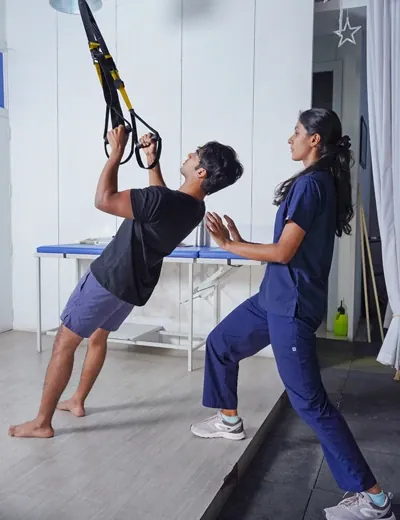
Your first visit takes 45-60 minutes. We listen to your story. We ask where and when it hurts, and what brings on the clicking or catching. Your physiotherapist then checks how your hip moves, how you stand and walk, and where you may be weak.
We explain the likely cause in simple words. You then get a treatment plan and exercises that suit you. We listen, you decide: we talk through the options, and you choose what works for you.
Follow-up visits take 30-45 minutes, and each one is one-on-one. We check how your hip is responding, adjust your exercises and move your plan forward step by step.
Our staff speak Tamil and English. Tell us when you book if stairs are hard for you.
Things you can try at home
These are gentle, general ideas. Stop and get advice if pain gets worse.
- Pause deep twisting.
For a while, avoid deep twisting, sharp pivots and sudden sideways moves that bring on the click or catch. If deep squatting or sitting cross-legged on the floor bothers your hip, use a chair for now.
- Small glute bridges.
Lie on your back on a mat or firm bed with your knees bent. Slowly lift your hips a little, then lower them. Keep the movement small, slow and comfortable. Skip it if it brings on the click, catch or pain.
- Side-lying clamshells.
Lie on your side on a mat or firm bed with your knees bent. Gently lift the top knee, keeping your heels together and your hips still. Lower slowly, and stop before any pinch in the hip.
- Easy core breathing.
Lie on your back on a mat or firm bed with your knees bent. Breathe out and gently draw your tummy muscles in without holding your breath. Relax and repeat a few times.
- Short flat walks.
Take short, easy walks on flat ground, such as a level path or a quiet street. Build up slowly, and avoid steep slopes and uneven ground for now.
Common questions
Does a clicking hip always mean a labral tear?
No. Many things can make a hip click or catch, and some hips click without any pain. A physiotherapist can check how your hip moves and explain what may be going on.
Can physiotherapy help a hip labral tear?
Many people find it helps. Treatment aims to ease pain, strengthen the muscles around the hip and improve how you control movement. Your plan depends on your assessment.
Should I stop playing sport completely?
Not always. Your physiotherapist may suggest easing off deep twists and pivots for a while and staying active in other ways. They can then guide a gradual return to sport when your hip is ready.
Is it okay to sit cross-legged or squat on the floor?
Some people find these deep positions bother a sore hip for a while. Your physiotherapist can suggest comfortable ways to sit and guide you on when to try them again.
Do I need a doctor's referral, and what should I bring?
No doctor's referral is needed. Please bring any reports, scans or prescriptions you have.
Can I ask for a female physiotherapist?
Yes. You can ask for a particular physiotherapist, or a female physiotherapist, at both branches. Just tell us when you book.
Book an assessment
 Mobiphysio physiotherapists · RS Puram and Goldwins
If your hip clicks, catches or aches when you move, an assessment can help you understand what may be going on. WhatsApp or call Mobiphysio on +91 73385 65909 to book. Appointments come first, so please message or call before you visit.
Our team has 25+ years of experience in physiotherapy and has treated 3000+ patients. Every plan starts with listening to you.
- RS Puram: No.28, Captain Palaniswamy Layout, opposite the municipal park, RS Puram, Coimbatore 641 002. Monday to Saturday, 10 AM to 8 PM. Open in Google Maps
- Goldwins, Avinashi Road: 11/23, Avinashi Road, opposite Sri Sai Dental Clinic, Karuparampalayam Pirivu, Coimbatore 641 014. Monday to Saturday, 8 AM to 1 PM and 4 PM to 8 PM. Open in Google Maps
Both branches are closed on Sundays and major festival days such as Pongal and Diwali. Both have ample car parking. Message us on WhatsApp or call; we will answer your questions.